
 by in
by in
What do I mean with this statement? Obviously, the endboard decides many games as the player who can’t break the other player’s endboard loses. So surely a deck’s endboard has to matter if games are decided by end boards. This is incorrect however, as many other factors matter more than the endboard of the deck, those being; consistency, non-engine, and the ability to go second. Throughout the rest of this article, I will be referring to a deck suffering from only having a good endboard as the “Six Sam Theorem” named after the best example of this, Six Samurai.
What is Six Samurai?
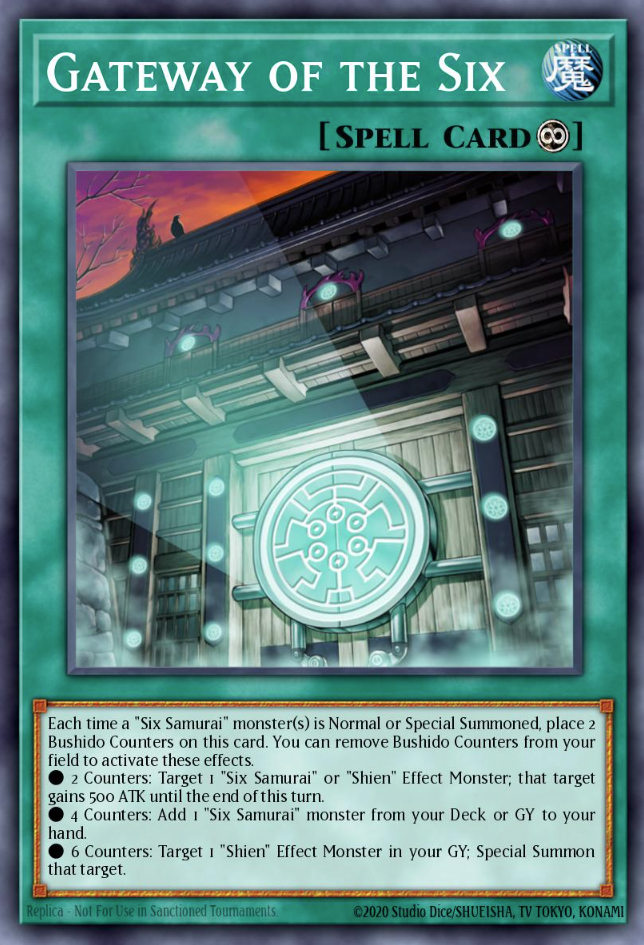
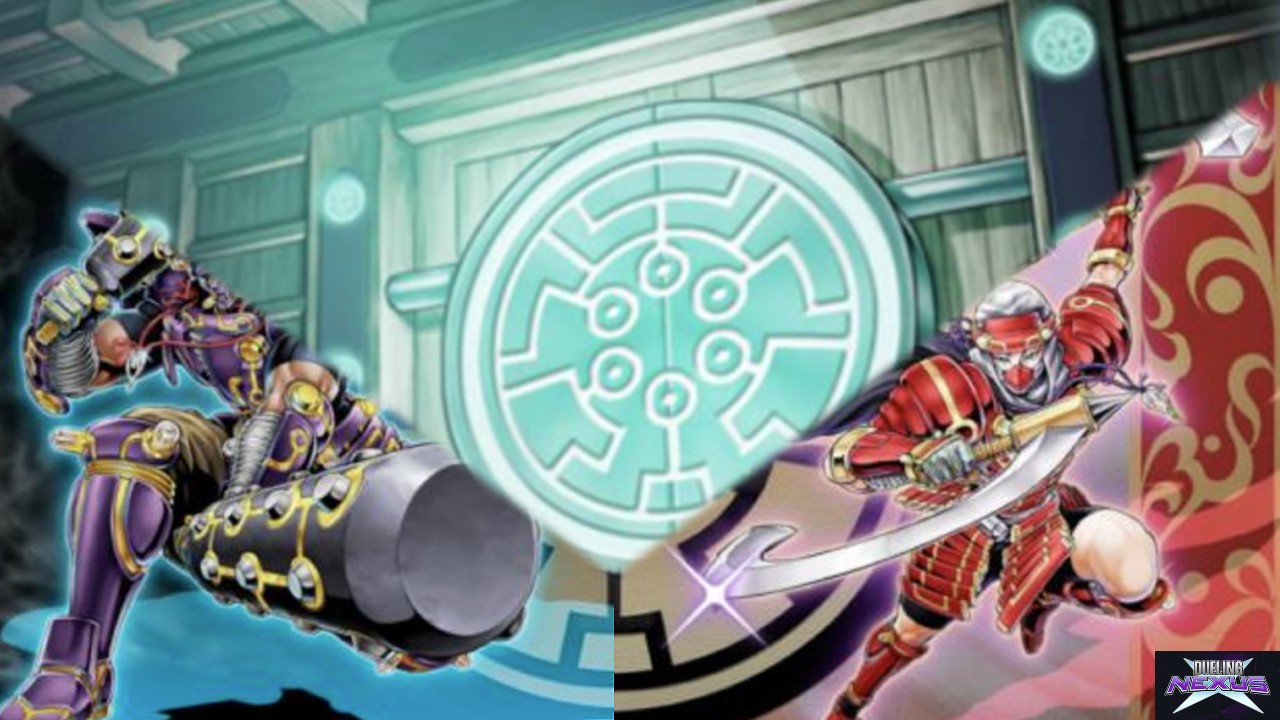
Understanding Six Samurai is crucial to understanding why endboards don’t matter. Six Samurai, or Six Sam, is a Yu-Gi-Oh! deck excelling at long combos and doing whatever it wants to do. The deck is able to do this because of its access to Gateway of the Six which is one of the best cards to date. It has an effect to place 2 counters on itself every time a Six Sam monster is summoned, and then it can remove those counters to activate different effects. The effect depends on how many counters you remove: If you remove 2 counters, a Six Sam monster you control gains 500 attack, if you remove 4 counters, you can add a Six Sam monster from your GY to your hand, and if you remove 6, you can reborn a Shien monster. None of these effects are once per turn so you can activate them as many times as you want.
Surely being able to activate this card as many times as you want per turn won’t be problematic, right? Wrong! Gateway enables Six Sam to do anything the deck wants to do because people have discovered an infinite loop you can do. This infinite loop gives you 2 more counters than you started with on completion. This results in an effectively infinite number of counters. Having an infinite number of counters lets the deck do anything it wants. The deck can FTK (First-Turn Kill) or it can make a big endboard consisting of whatever the pilot wants.
Is Six Samurai Good?
As you can probably tell by the introduction paragraph, Six Sam is not a good deck. But why is Six Sam bad, it sounds like a great deck that can do everything? Well, the deck can’t do everything, it actually has multiple fatal flaws. The first being its weakness into non-engine, the second being its inability to go second, the third being its inability to make a half board.
How do these “fatal Flaws” Hold it back?
The deck suffers into non-engine. This is mainly because the deck’s strength, is the only thing the deck is able to do. This means that if the Six Sam player is unable to access Gateway of the Six, they lose the game. Relying on keeping one card on the field makes the deck very susceptible to the opponent’s interaction. This flaw gets even worse when you realize that most modern decks play upwards of 15 non-engine, all of which can stop the Six Sam player from accessing Gateway.
The deck also suffers with going second, which is a flaw that, often times, makes a deck unplayable. Why does going second matter this much though? It matters this much because you are going to be going second in around 50% of the games you play. This means that if your deck can’t go second, your win rate will rarely be over 50%. Losing around 50% of games before you even draw your first 5 cards, makes the deck really bad.
And finally, the deck lacks the ability to make half boards. A half board is an endboard that decks pivot to after either being hand trapped multiple times, or being hit with a lingering floodgate. This is a very important trait as it can allow a deck to conserve resources and attempt to win on turn 3. It can also allow a deck to be more resilient to hand traps, as having the ability to make a half board can effectively hand-loop your opponent.
Other Examples
Making a claim with only one example wouldn’t be a very good decision as there wouldn’t be much evidence to support the claim. However, the Six Sam theorem has many other decks that struggle from it. Some notable examples include, but are not limited to: Genex, Dark World, T.G., Synchron (at the time of writing this, this may change with the new support), Blackwing, Exodia FTK, Gimmick Puppets, and HERO.
However, even though all of these decks prove the Six Sam theorem, they all do it in different ways. Some do it by having a big number of bricks they need to run, some have barely any non-engine room, some can’t go second, some can’t make a half board, etc.
How does this prove that Endboards don’t Matter?
This whole article has been explaining why a deck is bad, but it has yet to explain how this proves that endboards don’t matter. So, the following section will discuss the endboard/ceiling of Six Sam, and a few other similar decks as well as why they don’t help make the deck good.
Six Sam’s Endboard
As established earlier, Six Sam is a combo deck capable of achieving anything it wants. This is not an exaggeration; the deck can achieve literally anything it wants. The endboard this deck can produce are some of the best in the game. The deck can either FTK you if it wants to, or it can build a huge multi-negate board with layered interaction. The deck can even do both options at once if it really wants to. However, even with such an endboard, the deck is still not competitively viable because of the many flaws it has, and the deck having an infinite ceiling doesn’t offset any of the flaws.
Genex’s Endboard
Genex is a synchro deck revolving around Repair Genex Controller to summon a near infinite number of bodies to use as synchro material. This near infinite number of bodies lets the deck produce a wide variety of endboards. These endboard can range from hand looping the opponent for 5 or making multi-negate boards. However, the deck’s strength is also it’s weak point. Repair Genex Controller is a very obvious place to hand trap the deck, as without the card, the deck doesn’t function. The deck, like many others of its kind, can’t go second and loses to lingering hand traps such as Droll & Lock Bird and Mulcharmy Fuwalos.
Dark World’s Endboard
Dark World is probably the best of this kind of deck (as of writing this article, things can change over time). However, the deck is still not competitively viable. The deck is a somewhat inconsistent deck capable of drawing through its entire deck in one turn to access all the pieces it needs. This deck aims to hand loop the opponent for 6, yes 6, cards. This means that the player who goes second will not be able to play the game at all. However, the deck lacks non-engine room and loses to the Mulcharmy cards and Droll & Lock Bird which holds it back from being competitively viable.
Endboards in the Meta
To discuss the relevance of the endboard in the meta game I will go over two decks. One deck will have a weak endboard, the other will be similar to the other decks mentioned here, as it is defined by its endboard.
Primite Odion

The deck with a weak endboard, arguably the weakest in the meta game, is Primite Odion. What is Primite Odion’s endboard in terms of interaction with the opponent? A staggering, 0-2 negates. Surely having such a weak endboard is bad for the deck, right? Wrong, it’s great for the deck. Having a small endboard, means that the deck has very little engine to run. This leaves the deck builder with a lot of space to fill. The best choice in such a case is playing a very large number of hand traps to simplify the game state really quickly. In a simplified game state, such as one after both players have had to play through 3+ hand traps, a deck like Primite Odion excels. The deck has very good top-decks, all of which will help it keep the game state simple. In simple game states, there is no difference between 6-7 negates, and 2-3. Primite Odion takes advantage of this fact very well, leading to its success in the meta.
Lunalight

Lunalight, is like other decks on this list, defined by its endboard. However, unlike the other decks, it has seen success in the meta game and still does. Lunalight is the exception not the standard though. So, what separates Lunalight from the other decks that are defined by endboards? Lunalight can go second, it can play through hand traps, and the endboard is resilient. Lunalight is a deck centered on summoning Lunalight Liger Dancer, who is the boss monster of the deck. Why is Liger the boss monster? Liger is the boss monster because it is a tower and it is a Raigeki. This means that if the Lunalight player can make sure that Liger stays on the board, they win the game most of the time, regardless of if they went first or second. Lunalight relies on the fact that it is nearly impossible to out towers for most decks, and the fact that a lot of its cards are soft once per turns, to pry its way into the meta game.
What do These decks both have that the Other decks mentioned don’t?
Primite Odion and Lunalight are both meta relevant decks with different attributes that let them do so. However, they still share some of the same characteristics, even if they’re polar opposites. The characteristics they both share are they are able to go second, they excel at one thing and force the opponent to play their game, they are consistent, and their non-engine counts work well with the deck.
Conclusion
So, as you can see, the endboard in Yu-Gi-Oh! is not some monolith that represents the whole modern meta game. Matter of fact, it is arguably one of the least important parts of the modern meta game. This is shown through the failure of decks that are designed to build big endboards and nothing else, such as: Six Sam, Genex, Dark World, and others. By studying the flaws that the decks have, and how their endboard doesn’t help them, we can see what actually matters in the modern meta game, that being: non-engine, consistency, and the ability to go second.